
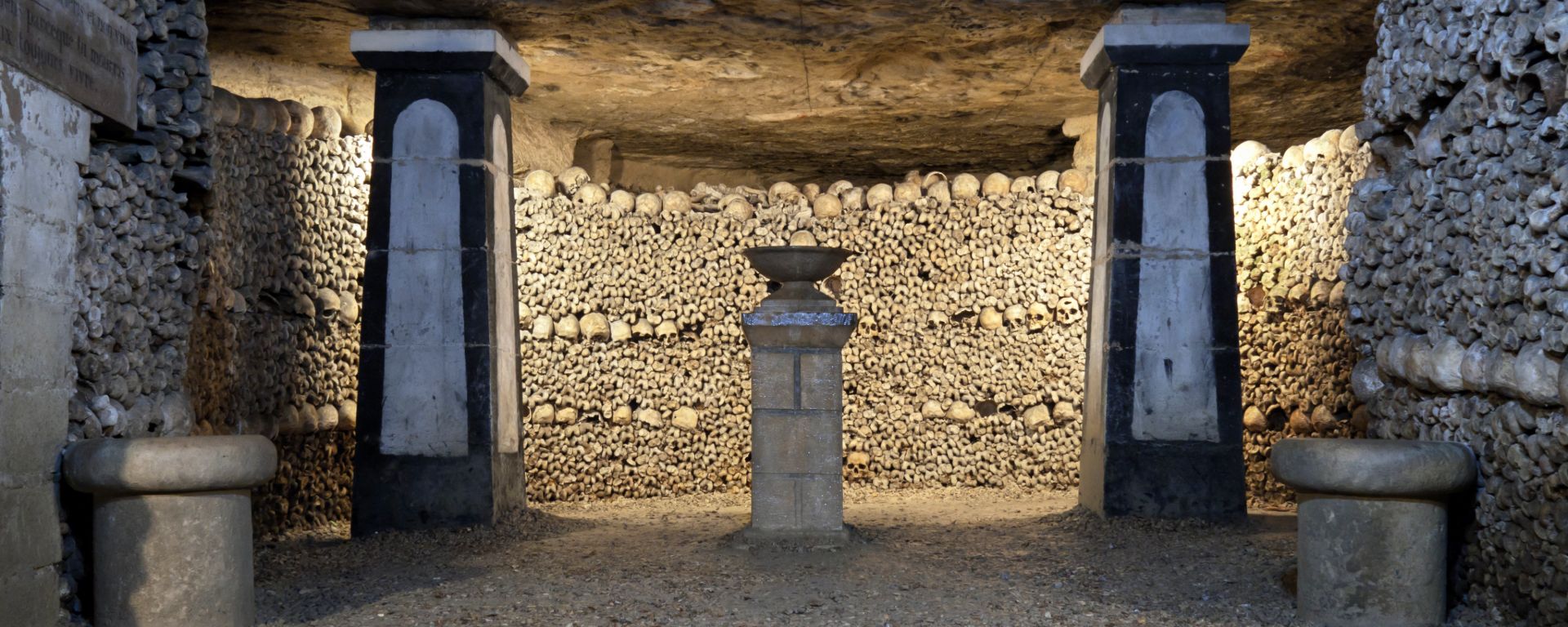
Paris is a city brimming with romance, glamour, and a host of bucket-list experiences. Strolling the Haussmannian boulevards, diving into sumptuous cafes and candlelit bistros, Paris is all about style and atmosphere. But beneath the Parisian pavements lies an underground world far from the glittering cosmopolitan city above ground. Here lies a very different atmosphere, surprising, grotesque, and undeniably tantalising for culture seekers looking for something extraordinary to add to their Paris itinerary.
This is your guide to the Paris Catacombs, a subterranean network of tunnels lined with the bones of the city’s historic inhabitants. It’s a mysterious and unforgettable experience that offers a moving counterpoint to the City of Light. This remarkable ossuary requires some strategic planning to ensure a seamless transition into this underground world – from choosing the best catacomb guide, knowing how and when to book, and preparing for the nuances of descending into this stirring subterranean world.

What Is the Purpose of the Paris Catacombs?
During the late 18th century, Paris found itself in a rather macabre public health crisis. Its cemeteries were overflowing. Les Innocents, a small graveyard dating to the 12th century, rather grimly burst its contents into a nearby cellar after months of heavy rainfall. The church turned a strong profit from the site, which contributed greatly to the saturated state of the cemetery. Finally, something was to be done. A network of old limestone quarries tunneled beneath the streets were chosen as a home for the souls of Les Innocents. Nightly processions with chanting priests moved the bones of an estimated two million, taking two years to complete.
At first, bones were haphazardly piled into the tunnel networks. In 1810, after approximately six-million corpses were moved to the catacombs from a number of cemeteries, a man called Louis-Étienne François Héricart de Thury restored the tunnels and placed the bones in a spectacular array of patterns and arrangements, perhaps a final mark of respect to the millions of souls now in their final resting place. It became and stands to this day as the largest ossuary in the world.
Best for: History lovers seeking a more unusual side of Paris
Secret tip: Visit early in the morning for the quietest atmosphere and fewer tour groups
The 7-Day Strategy: Booking Window Release Dates
So you’ve added the Paris Catacombs to your itinerary. But what next? As one of the most visited tourist attractions in the city, a little planning can ensure you don’t get caught up in the visitor throngs. Tickets regularly sell out, particularly from April to October. Peak season is of course a glorious time to visit Paris, so fret not, we have the insider scoop on booking window release dates.
The official booking system releases timed-entry tickets seven days in advance, so it’s worth setting that calendar reminder to ensure you snap up yours. Once secured, it’s worth noting that even with standard tickets, queues can remain lengthy, especially during weekends and school holidays. This is where premium access becomes worthwhile.
Best for: Travellers visiting Paris during spring, summer or festive weekends
Secret tip: Set a calendar reminder exactly seven days before your intended visit date

Audio Guide vs. Live Guide: The VIP Verdict
We’re all about helping savvy travellers, but being savvy doesn’t have to mean going for the most affordable option. There’s a lot to be said about booking a private tour and guide for the catacombs. The tunnels and seemingly-endless rows of bones are laden with atmosphere, evoking a strong emotional reaction. The personal touch of a guide who can bring the catacombs’ stories to life is oftentimes worth the added expense. From the ossuary to the revolution, WWII resistance and more, nothing quite matches the immersive qualities of these smaller and more personal tours.
The standard audio guide offers flexibility and affordability and is highly regarded by visitors. It allows visitors to move independently through the tunnels while learning the historical background at their own pace. For confident solo travellers, or those who prefer the independence to explore without particular time constraints, this is also a great option.
Best for: Flexibility: choose which way to explore suits you best
Secret tip: Evening guided tours often feel significantly more atmospheric than daytime slots

Survival Style: What Shoes to Wear for Catacombs
One of the most overlooked details when exploring the catacombs is footwear. Visiting the catacombs is rather more physical than most imagine, with roughly 130 spiral steps to go up and down, plus uneven stone flooring, oftentimes damp, that can be tricky to navigate. So wear decent shoes, grippy ones, comfy ones – we love Paris for its style, but this is one experience worth dressing down for.
Travellers often underestimate the physical nature of the experience. The route includes narrow staircases, uneven stone flooring, occasional damp patches and approximately 130 spiral steps both descending and ascending.
On a further note, the tunnels also remain cool year-round – typically hovering around 14°C – so layering is essential even during summer heatwaves above ground.
Best for: Visitors combining the catacombs with a full day of city exploration
Secret tip: Bring a lightweight jacket even in July or August
Where’s Good to Stay in Paris?
Where isn’t? If the Paris Catacombs are the only reason for visiting, and you want to be in the heart of the action as quickly as possible, the 14th Arrondissement is a distinctly local-feeling place whilst still being well connected to the rest of the city. However, for a little more elegance, the nearby Latin Quarter is a well-heeled area of the Left Bank and a great jumping off point for your Parisian exploits.
For longer stays, the Left Bank remains one of the most rewarding areas in the city – less hurried, more literary and perfectly suited to slow evenings after exploring.
Best for: Luxury travellers seeking atmosphere over tourist-heavy locations
Secret tip: Stay near Denfert-Rochereau for the easiest morning access to the catacombs
So there it is. A little careful planning, and the beguiling catacombs await. Turn the glamour of Paris on its head with an unforgettable tour of the city’s most curious sights. It’s not one you’ll soon forget.
FAQs
Are the Paris Catacombs safe for claustrophobic travellers?
They are of course safe, however it is ill advised if prone to anxiety in confined spaces to visit. Remember there’s 130 steps down, the passages can be narrow, and the floor uneven and sometimes slippery. If you’re concerned, it’s perhaps not the right experience for you.
Which is the best month to travel to Paris for shorter queues?
Shoulder seasons (spring and autumn) and winter are generally unpopular times to visit the city, however the quieter streets and more local feel can prove wonderfully alluring…
Can I bring a bag or stroller into the underground tunnels?
A bag no more than 40x30cm is permissible. A stroller is not. The route is a one-way journey, so it is not permitted to leave anything at the entrance for collection.
How long does a full tour of Paris beneath the pavement take?
A standard visit takes around an hour, not accounting for the stairs down and up again. Plan on booking out 1.5-2 hours in total.
Discover Secret Escapes’ Handpicked Paris Deals
Let the allure of Paris captivate you with Secret Escapes’ outrageously bookable deals.
For more travel advice and inspiration, deep dive further into the Escapist magazine, or get in touch for more information on outrageously bookable deals.