
Martian deserts, UNESCO World Heritage Sites, unforgettable hospitality and boundless antiquities make Jordan a place of true exploratory enlightenment
The Hashemite Kingdom of Jordan shares borders with Syria, Israel and Saudi Arabia, and for this reason many overlook its wonders with questions of safety. But fear not, for Jordan is a Middle Eastern haven; a sanctuary tucked amongst its politically unstable neighbours; a place where the kindness of strangers weaves itself into day-to-day life. Forget Petra, the enchanting desert landscapes and the Roman ruins, for a moment. If you choose only one reason to visit Jordan, out of the many thousands that exist, choose this: the people. Jordanians are generous, kind and welcoming; hospitality here is not an industry or a profession, but a ritual. From taxi drivers to random strangers, Jordanians will welcome you with open arms.

A whistlestop tour of Amman:
To embrace a Jordanian adventure, the first thing you must do is let go; relax into the rush, embrace spontaneity. And where better to experience it all than Amman, Jordan’s sprawling capital.
Eat: Hashem’s Restaurant
To truly understand Amman’s dining culture, a visit to Hashem’s is a rite of passage. Tucked between two exposed concrete buildings with electricity wires running across its fabric roof, you wouldn’t look at Hashem’s and think ‘I bet this is one of the King of Jordan’s favourite restaurants’ – but it is. There’s no menu here, you get what you’re given. Crunchy-soft falafel, butter-smooth hummus, smokey moutabel and ful medames, a dish of garlicky mashed fava beans. And there’s no cutlery either. Scoop it all up with bite-sized pieces of pillowy flatbread, wash it down with tooth-achingly sweet mint tea and settle into the city as it rushes around you.
Drink: Books@Cafe
Surrounded by plant life with views across the city from its terrace, Books@Cafe on Amman’s lively Rainbow Street is a little bit of everything. Part book shop, part art gallery, part cafe, part cocktail and shisha bar, Books@ is where locals, expats and tourists alike go to read, brunch on Saturdays and come together. It was the Middle East’s first internet cafe when it opened in 1997, and is now a hub for Amman’s LGBTQ+ community, a place that celebrates peace, equality and liberation.
Visit: Amman Citadel
In 63 BCE the Romans conquered much of the Levant, a large area of land which covered modern-day Jordan, Syria, Lebanon, Israel, Palestine and most of Turkey. The most impressive remnant of Roman history here is undeniably the Amman Citadel. Surveying the city from a mammoth hill, the Citadel has been occupied since 10,200 BCE – and its history spans a revolving door of civilizations who each contributed to the progression of Amman during its 12,000-year history.
Experience: Cooking class
A taste of Grandma’s cooking — that’s the aim of cooking class-cum-cultural experience Beit Sitti. In a stone house tucked in the streets of Jabal Al Weibdeh, the oldest neighbourhood in Amman, three generations of the Haddad family come together to teach their grandmother’s recipes. On a warm night there’s nothing better than sitting on their leafy terrace learning how to make Makloubeh, a dish of cauliflower, rice and chicken, which is flipped when served (makloubeh literally translates to ‘upside down’). As the sun sets, the orange sky blends with the sandy-stone buildings as you hear the call to prayer ring out from mosques across the city.

Petra: A city of stone
As one of the Seven Wonders of the World, Petra is a bucket-list stop. This sandstone city was carved from the rock in the 3rd century BCE by the Nabateans, a nomadic Bedouin civilisation who controlled a large swath of the northern Arabian peninsula before the Romans. They were master builders in every sense: experts in hydraulic engineering, iron production, and water irrigation, and accumulated wealth by taxing the long caravans of traders that passed through their territory. But by the 5th century, Petra had fallen to the Romans and the Nabatean kingdom became unimportant, thanks to the flourishing sea trade route, and their land was eventually split between Arab invaders. The city of Petra, once home to 20,000 people, was forgotten to all but a few, whose descendents are the Bedouins that live around Petra today.
These days, every visitor enters Petra in the same way: a long walk on loose sandy ground towards the Siq, a kilometre long, high-walled canyon of striking fired-orange stone. The path meanders between the wave-like canyon walls, until, miraculously, the Treasury appears before your eyes. If you set off towards the Siq soon after 6am, you’ll experience the Treasury, known to the Bedouins as Al-Khazneh, in its most tranquil state. One look at its intricate, hand-chiselled facade will leave you in awe – a 40-metre-tall tribute to perseverance in the face of the seemingly impossible.
Some tourists walk the Siq, see the Treasury and turn around, thinking they have seen the only sight worth seeing, the one made famous in the western world by Indiana Jones’ galloping crusade. But they could not be more wrong – everything here is worth seeing, and it’s estimated that 85% of this once-thriving city still lies undiscovered. The Royal Tombs, carved into a hillside, show what might have been the quarters of the Nabatean rulers, while the Theatre, an 8,000-spectator auditorium, gives evidence of an ancient city alive with culture and celebration.
Then there’s the High Place of Sacrifice. Up above Petra’s jabals, this impressive panorama is well worth the short yet steep climb. Here, so near to the sky, where the tourists and Bedouins, their backpacks and camels, are specks below you, it becomes clear why the Nabateans chose this as their most holy of places.
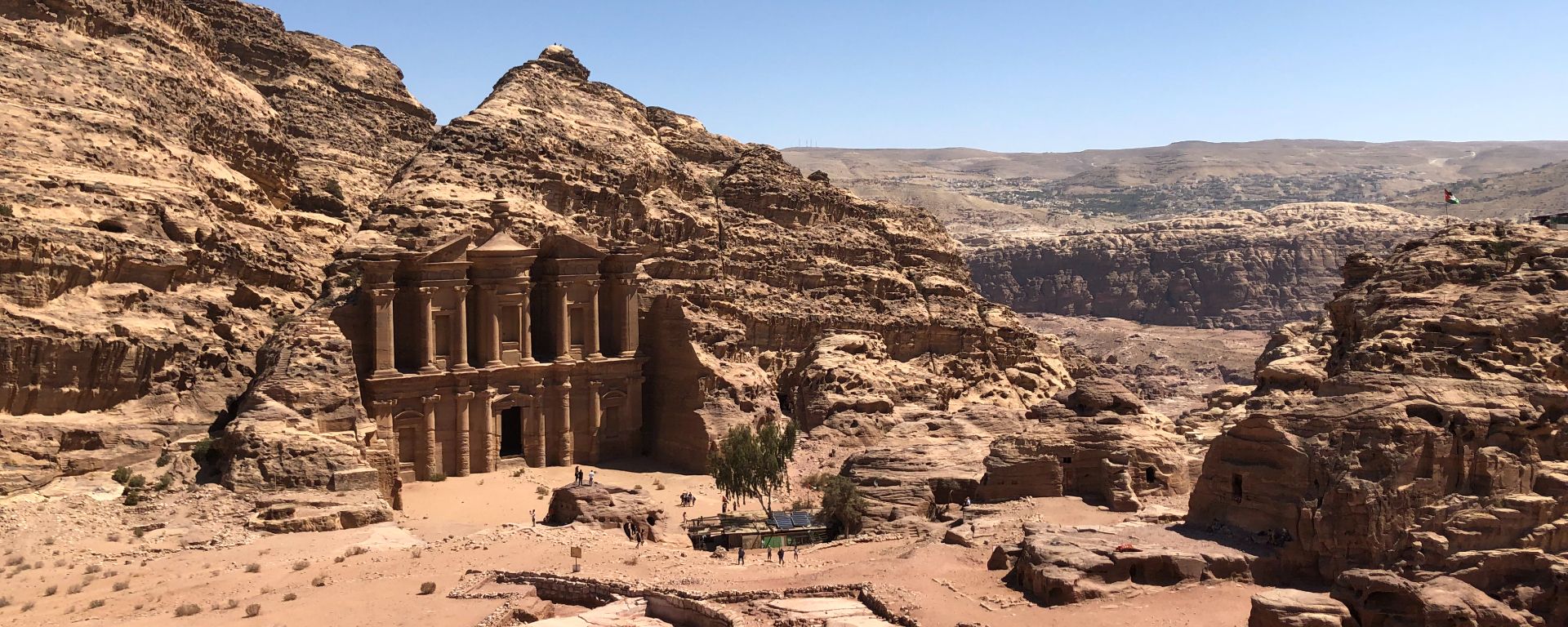
And finally, the Monastery. Tucked high up in the hills, Ad-Deir is perhaps the most taxing of places to reach, but the one which brings the most heartening sense of achievement. To follow the ancient processional path, 800 deep steps used by the Nabateans and the Romans, feels monumental. Unlike many of the structures in Petra, Ad-Deir contained no tombs, and was therefore determined not to be a mausoleum, as the Treasury is, but a church. A journey up to this mountainous spot, which on clear days offers views all the way to Israel, certainly feels like a pilgrimage.

The wildness of the wadis
Jordan’s wadi valleys vary greatly in size and shape, from the gorge-like trail of Wadi Mujib to the arid, mars-like expanse of Wadi Rum. That these other-worldly landscapes vary so much is unsurprising—between mountains and deserts, seas and weaving rivers, Jordan is as biologically diverse as it is beautiful.
Less famous than its sister Wadi Rum, Wadi Mujib is the lowest nature reserve in the world. From its humble beginnings off the side of the Desert Highway, this deep gorge boasts a 1,300m variation in elevation, running through the Karak and Madaba mountains all the way to the Dead Sea, where it spills out 410m below sea level. This winding feat of nature is not just a haven for biodiversity, but a utopia for adrenaline junkies. Spectacular waterfalls, startlingly blue natural pools and ziplines come together to create exciting trails for every adventurer. Even the dry parts of the wadi are thrilling—keep your eyes peeled and you might spot a nubian ibex, of which there are fewer than 10,000 left on earth.
No trip to Jordan is complete without a day and night spent in the never-ending expanse of Wadi Rum. Also known as the Valley of the Moon, Jordan’s largest wadi spans 280-square-miles of burnt orange dirt, other-worldly rock formations and flowing sand dunes marked with circling Jeep tracks. In fact, this desert is a favourite of Hollywood filmmakers, with movies like The Martian, Dune, Star Wars: The Rise of Skywalker and Disney’s Aladdin remake all making use of its unforgettable vistas to bring their fictional worlds to life.
Occupied by the Nabateans prior to Petra, Wadi Rum’s past is certainly as interwoven in the history of Jordan’s ancient civilisations as its fellow tourist sites. It also has ties to the western world. Wadi Rum is, to some, most famous for its connection to T.E. Lawrence, also known as Lawrence of Arabia, who was a British Army Officer, archaeologist and diplomat who helped unite Arab tribes to rebel against the Ottoman Empire. His life was chronicled in his book, The Seven Pillars of Wisdom and later in the 1962 film. Deep in the desert, history buffs and movie fans can visit the remains of the house where Lawrence was said to have lived for a time in 1917.

To truly experience this desert, you should go back to basics. Hot air balloons will have you soaring above the land, and the views are undeniably fantastic, but riding a camel through the desert at sunrise, watching as the glow appears over the mountains and sets the orange earth alight, is something else all together.

For the Bedouins who call Wadi Rum home, camels have been a part of life, a life wildly altered by tourism, for centuries. Many who would have once lived nomadically have instead put down roots and traded the life of their ancestors for a steady income and guaranteed necessities, like water. Though some may see this as a way of life in ruins, it all comes back, as many things do in Jordan, to hospitality. Welcoming guests is a matter of pride, and this is no different for Bedouins, whose culture stipulates that those travelling through the desert must be helped with water, comfort and shelter. Those travelling through their lands, and their reason for doing so, may have changed, but the response of the Bedouins has not and likely never will.
Feeling inspired?
Discover our handpicked Jordan deals today
Whether you’re dreaming of discovering Petra, embracing the wilds of the wadis or heading to the unique waters of the Red or Dead Seas, find your perfect deal today with a collection of packages and incredible hotel offers.

